Ghost ants and rover ants present distinct behavioral challenges in East Hillsborough County homes, especially in high-moisture subdivisions like Providence Lakes, Heather Lakes, and Bloomingdale. Ghost ants measure…
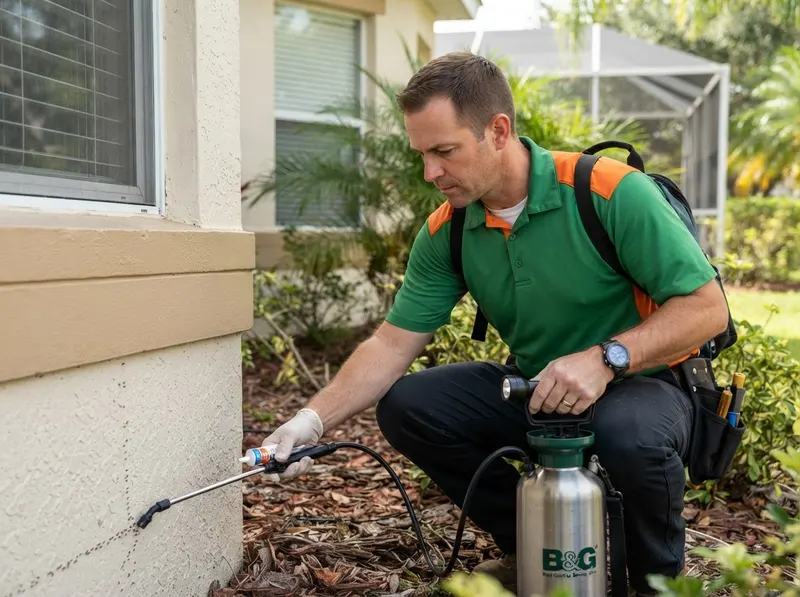
Ghost ants and rover ants present distinct behavioral challenges in East Hillsborough County homes, especially in high-moisture subdivisions like Providence Lakes, Heather Lakes, and Bloomingdale. Ghost ants measure 1.3 to 1.5 millimeters with translucent abdomens and dark heads, frequently trailing into kitchens near sink plumbing and moisture-compromised drywall. Rover ants measure 1.5 to 2 millimeters, display a dark brown or blonde coloration with 9-segmented antennae, and commonly establish satellite colonies inside wall voids, electrical switch plates, and mulch zones. A primary mistake homeowners make is spraying synthetic pyrethroid retail insecticides directly onto visible trails; this triggers colony budding, splitting a single multi-queen colony into three to five separate reproductive centers scattered throughout the home.
Effective suppression relies on Integrated Pest Management (IPM) rather than indiscriminate chemical broadcasting. The intervention begins by mapping moisture gradients around interior wet walls and perimeter masonry joints near foundational shrubbery. Slow-acting carbohydrate and protein gel matrices are introduced in pin-drop amounts inside concealed service tracks. Foraging worker ants ingest these matrices and transfer the active ingredient through trophallaxis to the queens and larvae over a 7- to 14-day cycle. Applying pyrethroid sprays creates an immediate repellent barrier that prevents bait consumption, prolonging the infestation and forcing foraging ants into bedrooms and pantries.
Exterior suppression pairs granular bait applications in damp soil with a targeted non-repellent barrier along the foundation wall. In neighborhoods such as Brentwood Hills, Limona, and Brandon Hills, mature live oaks and heavy subtropical turf facilitate outdoor nesting. Rover ants feed extensively on honeydew produced by aphids and scale insects inhabiting landscape plants. Trimming back foliage 12 inches from stucco siding and clearing organic mulch beds bordering concrete slabs cuts off high-volume transit lanes into attic eaves and window frames. The operational trade-off of biological suppression is eradication speed versus colony mortality: broad-spectrum sprays yield an immediate visual knockdown of trailing workers but leave underground queens intact, whereas slow-acting micro-baits require 10 to 14 days to achieve total nest collapse without scattering queens into uninfested rooms.
Every job gets a firm, written price after a free on-site visit.
Tell us about your ghost ant and rover ant suppression job in Brandon and we'll send a clear, written quote, usually the same day.
 Cypress Finch Pest Control