Subterranean termite pressure in Eastern Hillsborough County is driven by sandy, high-moisture soils and subtropical temperature cycles that keep colonies active 365 days a year. Unlike drywood species that nest inside…
Subterranean termite pressure in Eastern Hillsborough County is driven by sandy, high-moisture soils and subtropical temperature cycles that keep colonies active 365 days a year. Unlike drywood species that nest inside attic rafters, subterranean termites live beneath the soil line and require continuous ground moisture to survive. Workers construct mud shelter tubes across exterior concrete footings, stem walls, and plumbing cutouts under bathtubs to reach pine wall framing and drywall cellulose. Neighborhoods established along former citrus and hardwood parcels, such as Limona, Brandon Hills, and Heather Lakes, often feature mature subterranean networks whose foraging galleries extend over 100 feet from an outdoor nest.
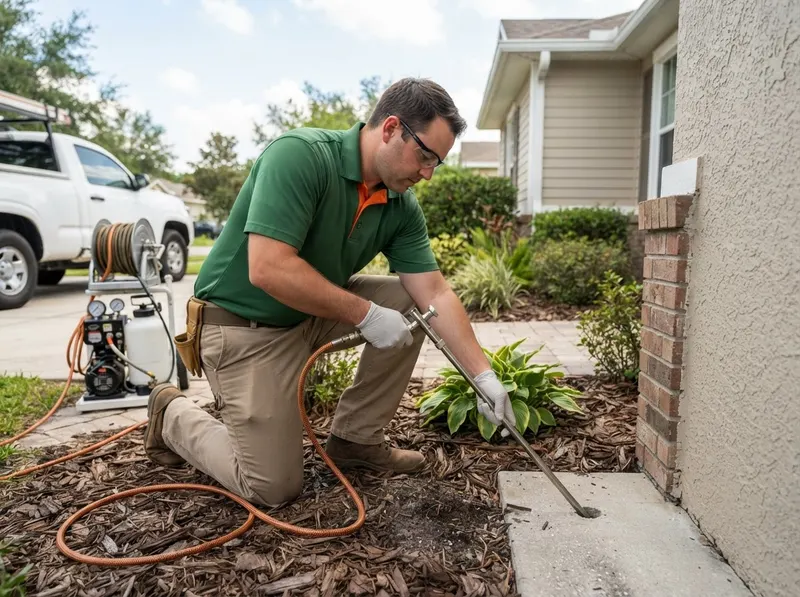
Effective structural protection requires choosing between a liquid non-repellent barrier and an exterior bait station perimeter. A liquid barrier treatment involves excavating a continuous 6-inch by 6-inch trench into the soil directly adjacent to the foundation slab, rodding the solution deep toward the footers, and treating backfilled soil at a standard rate of 4 gallons per 10 linear feet. Products like non-repellent termiticides allow worker termites to pass through the treated zone undetected, transferring the active agent to the queen and nesting members through normal social grooming. For properties with expansive concrete patios, pool deck pavers, or complex root systems near foundations, frequently observed in Bloomingdale, Valrico Forest, and Sterling Ranch, drilling concrete every 12 inches is necessary to establish an uninterrupted chemical envelope.
In scenarios where homeowners prefer minimal ground disturbance or zero perimeter drilling through decorative stone, subterranean baiting systems provide an alternative. Exterior bait stations are installed flush into turf every 10 to 15 feet around the drip line. Termites forage on internal wood and cellulose matrices embedded with an insect growth regulator, disrupting chitin synthesis during molting and leading to complete colony elimination. While bait stations eliminate the need for drilling, the trade-off is response duration: a perimeter liquid termiticide provides an immediate protective boundary against building ingress, whereas biological baiting relies on natural worker discovery and typically takes 60 to 90 days to achieve full colony collapse.
Treatments are executed sequentially to secure the structure without unnecessary pesticide exposure inside living quarters. 1. A complete interior and crawlspace acoustic and thermal imaging assessment pinpoints hidden moisture pockets and mud leads. 2. Exterior perimeter clearing removes dense landscape mulch and soil-to-wood ground contacts. 3. Sub-slab injection or trenching applies the protective non-repellent zone around the entire linear foundation. 4. Interior voids exhibiting active feeding receive localized dry-foam applications to halt structural degradation immediately. This protocol delivers long-term colony control while keeping indoor living spaces free from persistent airborne chemicals.
Every job gets a firm, written price after a free on-site visit.
Tell us about your subterranean termite treatment job in Brandon and we'll send a clear, written quote, usually the same day.
 Cypress Finch Pest Control